
 English
 Français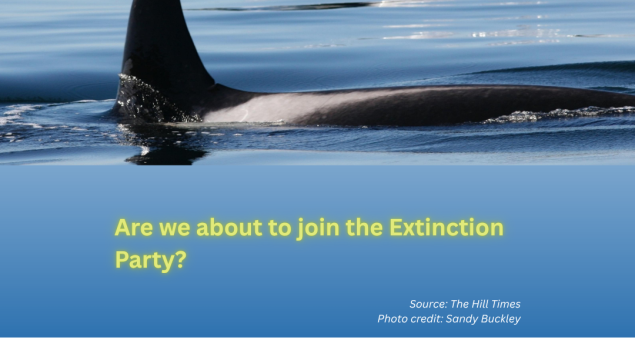
Under a federal proposal, should the government decide that a project is in the public interest, then it would have the power to condemn to oblivion any species that is standing in the way.
Be careful when fighting monsters, lest you become one. That precept may not have the panache of "build, baby, build" or "Canada strong," but it speaks accurately to where our economic battle with the United States has led us.
Last month, in its pursuit of Asian markets, the Carney government proposed meddling with the most basic of all our environmental commitments. It asked parliament for the discretion to discard the "jeopardy test," the red line in Canada's Species at Risk Act that prohibits the government from willfully approving extinction. Should the government decide that an oil pipeline or other project is in the public interest, the, under the prim minister's proposal, it would have the power to condemn to oblivion any species that is standing in the way.
The government has already received thousands of responses to this proposal and other in its new major projects package—and for good reason. The Toronto Star reported that the first species in the Liberals' sights are the British Columbia's resident orcas. Yes, those orcas: symbols of the province and honoured relatives of many coastal Nations. When, in 2028, a mother orca named Tahlequah refused, in her grief, to relinquish her stillborn calf and kept the body afloat for 17 days beside her, people from across the country shared the loss. Now the Carney government wants authority to vote the orcas dead.
What country writes extinction into its laws? Not our would-be partners in Europe. Their wildlife directives contain exceptions, called "derogations," through which even endangered animals may be harmed or killed—but not to the point of jeopardizing a populations' survival in the wild. For such allowances, one must turn to the U.S. And that puts Prime Minister Mark Carney's government in some very dubious company.
Just two months ago, Pete Hegseth, the self-dubbed U.S. Secretary of War, determined that oil companies should have carte blanche to extirpate endangered species from the Gulf of Mexico. A special committee was convened, known as the "God Squad" for the existential power it holds over wildlife, and America's own "jeopardy test" was lifted. I know the matter well because my organization is trying to stop Hegseth's exemption in the courts. Yet somehow the lesson the Liberal Party has drawn from all this is that Canada needs its own God Squad.
Party leadership is assuring concerned MPs that Canada is different, that the legislations they'll table will have safeguards. But the U.S. provides an object lesson in the difficulty of reining in future governments once exemption powers are granted. The U.S. Congress threw in safeguards around its jeopardy exemption like they were going out of style: evidentiary requirements, justiciable standards, a hearing before an administrative law judge, cabinet-level involvement, and public access to every document and every stage of the review. For decades those guardrails held: then they were swept away by an administration with a maximalist view of its authority.
The prime minister's proposal would harm Canada's wildlife well before any decisions to condemn species are made. Legal scholarship tells us that wildlife legislation achieves much of its benefit through the behind-the-scenes negotiations that occur—between government and project proponents—over measures to reduce harm. But how do negotiations work when everyone knows that proponents have an ace up the sleeve?
Canada has built an international reputation over decades for its commitment to sustainability. Should it ever vote to jeopardize its iconic orcas, that reputation would sink overnight to Trumpian levels of opprobrium, hardly the "better, stronger, and more just," world that Carney's Davos speech envisioned. It is work asking what right Canada has to condemn commercial whaling or climate backsliding when, with the likes of Hegseth, we have normalized the idea that governments can choose extinction. That may now be the way of our southern neighbour, but, for a nation endeavouring to provide leadership in a shaken world, there are some lines that shouldn't be crossed.
Michael Jasny is the director of marine mammal protection at the Natural resources Defense Council. He lives in Vancouver, and is battling 'God Squads' on both sides of the border.
Full article originally published at The Hill Times June 10, 2026.
Appuyez Living Oceans

Votre appui nous permettra de convertir les élevages de saumon en systèmes à circuit fermé, garder nos côtes libres de pétroliers et finalement protéger nos trésors nationaux que sont nos régions côtières.
Pour en savoir davantage sur nos Océans
Abonnez-vous et soyez les premiers à recevoir de l'information sur nos campagnes et sur les problèmes qui affectent nos océans et les communautés vivant sur les côtes. Recevez aussi les "Alertes à l'action" pour pouvoir vous impliquez encore plus. Consultez notre politique de confidentialité.
Passez à l'action
Vous pouvez faire toute la différence dans la santé de nos océans
- Appuyez nos campagnes
- Tenez-vous au courant des problèmes affectant nos océans
- Faites du bénévolat
- Exigez une amélioration des lois sur la conservation
- Participez à notre concours de photos
- Rapporter les débris marins que vous avez trouvés